Here is the breakdown of how these two workhorses differ where it counts: in their lifting muscle and their internal "guts."
[caption id="" align="aligncenter" width="500"]
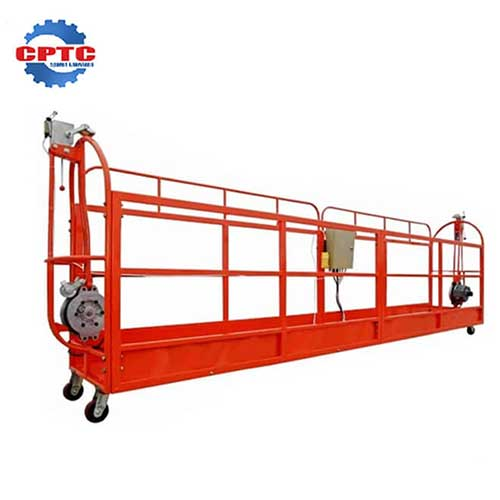 ZLP Series Suspended Platform[/caption]
1. Load Capacity: The 170 kg Difference
The most obvious distinction lies in their names, which reflect their rated lifting tension in kilonewtons (kN).
LTD6.3: Rated for 630 kg (6.3kN). This is the industry
standard for most standard two-man platforms used for window cleaning or light painting.
LTD8.0: Rated for 800 kg ($8.0text{ kN}$). This model is the "heavy lifter" of the standard range, designed for platforms carrying heavier materials, multiple workers, or complex glass replacement tools.
Why it matters:
Using an LTD6.3 for a job that teeters near its limit leads to faster motor fatigue and brake wear. Conversely, using an LTD8.0 for a light job is "over-spec," providing a higher safety margin but adding slightly more weight to the platform setup itself.
2. Internal Gear Differences: Precision vs. Torque
While both hoists often utilize an "α" (alpha) type cable-guiding system, the internal gearbox is where the LTD8.0 justifies its higher rating.
Gear Ratio and Torque
To lift 800 kg without burning out the motor, the LTD8.0 typically employs a different reduction ratio compared to the 6.3. By increasing the gear reduction, the hoist generates more torque at the traction sheave. This means the motor doesn't have to work exponentially harder to lift the extra 170 kg.
Material Strength
Because the LTD8.0 experiences higher internal pressures on the gear teeth:
Hardened Alloy Steel: The gears in the 8.0 are often subjected to more rigorous heat treatment (nitriding or carburizing) to prevent "pitting" or tooth deformation under high loads.
Worm Gear vs. Planetary: Most LTD series use a combination of a motor-driven worm gear for initial reduction. In the 8.0, the worm wheel is usually made of a higher-grade centrifugal cast bronze to withstand the increased friction and heat generated by the heavier load.
Traction Sheave Grip
The internal traction wheel (the part that actually grabs the wire rope) in the LTD8.0 is designed with a more aggressive "V" or "U" groove profile. This ensures that the rope doesn't slip when under the maximum 8.0 kN load, a critical safety factor that differs from the slightly smoother profile of the 6.3.
Quick Comparison Table
| Feature | LTD6.3 Hoist | LTD8.0 Hoist |
| Rated Lifting Force | 630 kg | 800 kg |
| Lifting Speed | ~9.3 m/min | ~9.3 m/min (higher torque motor) |
| Standard Motor Power | 1.5 kW | 1.8 kW or 2.2 kW |
| Braking Torque | Standard | Reinforced / Higher Friction |
| Common Application | General maintenance | Heavy construction / Glass installation |
Which One Do You Need?
Choosing between these two isn't about "bigger is always better."
Go with the LTD6.3 if you are running a standard maintenance fleet. It’s lighter, parts are ubiquitous, and it’s perfectly balanced for standard 2-meter to 6-meter platforms.
Go with the LTD8.0 if your projects involve "heavy" lifting—think masonry repair, heavy-duty waterproofing, or installing large-format glass panels. The extra headroom in capacity isn't just about safety; it’s about the longevity of the internal gears.
Pro Tip: Regardless of which you choose, remember that the internal gear lubricant is the lifeblood of these machines. Because the LTD8.0 runs hotter due to the higher load, checking your oil levels isn't just a suggestion—it's a requirement for survival!